
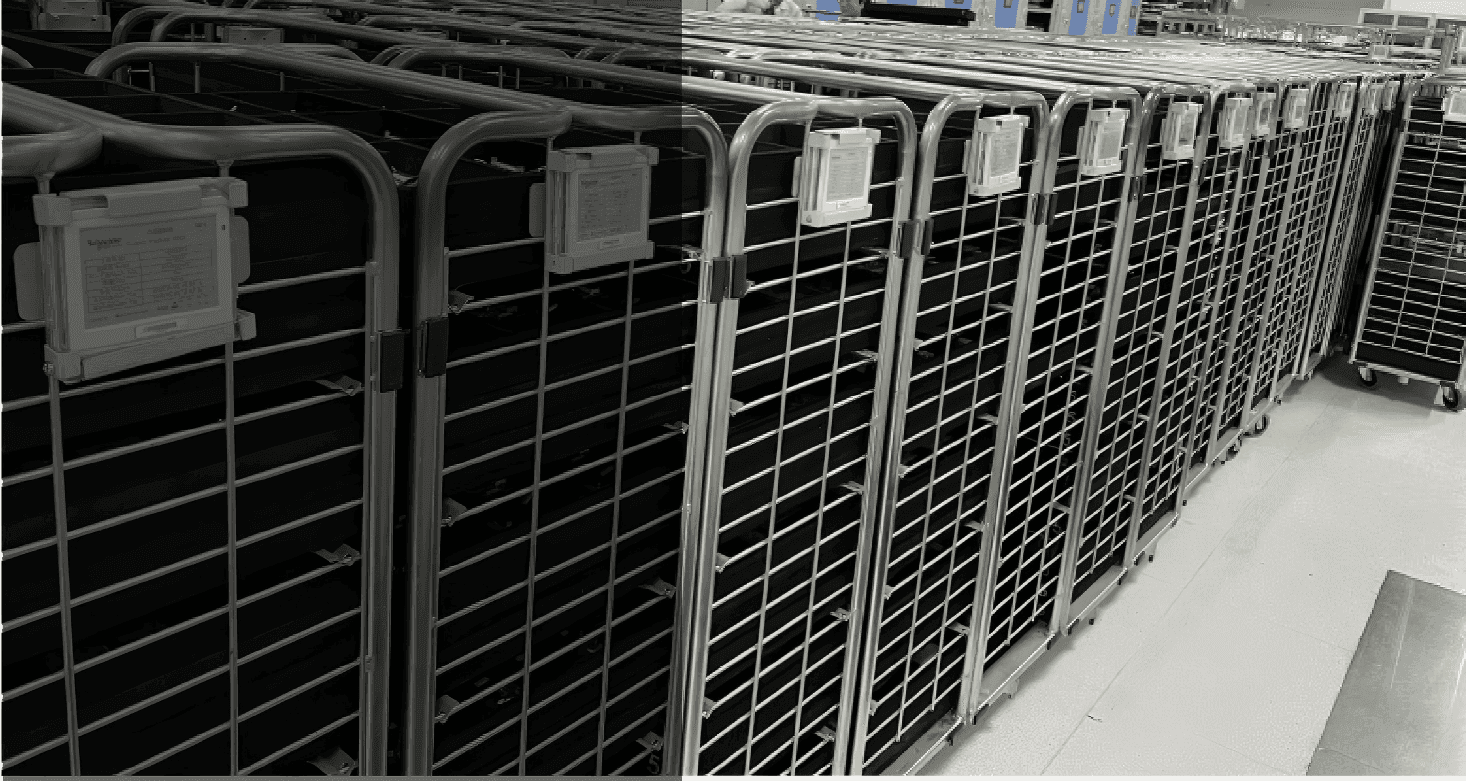
Eliminating the "Line-Side Black Box": How Wire-Free Visualization Supercharges Lean Logistics (Part 1)
Moving beyond adhesive paper labels to solve data latency, tracking errors, and high-concurrency routing bottlenecks in High-Mix Low-Volume manufacturing.
Back to News CenterE-ink Solutions for Lean Logistics
When lean manufacturing practitioners talk about Muda (Waste), they often overlook the hidden tax of physical infrastructure setup. In traditional high-concurrency logistics hubs or built-to-order assembly lines, managing material flow requires strict sequence compliance. Yet, the method used to convey instructions remains stuck in the past: static paper travel tags, thermal stickers, and plastic folders.
This creates an operational paradox. Your backend Warehouse Management System (WMS) operates in milliseconds, but your frontline material tracking relies on human transit times, barcode scanning bottlenecks, and physical paper scraping. This is where lean principles gridlock. Here is how a wire-free, multi-protocol industrial E-ink ecosystem changes the economics of shop-floor logistics.
1. The Core Friction: High-Mix Low-Volume Changeover Latency
In modern smart manufacturing, custom production runs mean SKU changeovers happen multiple times per shift. In a traditional paper-driven setup, every changeover triggers a sequence of non-value-added actions:
- Internal IT systems generate a new material pick-list.
- Operators print, sort, and physically transport thermal stickers or paper folders to line-side staging racks.
- Frontline kitting workers manually peel, scrape off the old adhesive residue, and slap on the new label.
This process introduces what lean management calls Processing Waste and Waiting Waste. A smudged barcode or a misplaced label instantly creates a line-side "black box"—the central system assumes the carrier has entered the cell, but physical assembly grinds to a halt due to material mismatch.
2. The Solution Framework: Wire-Free Multi-Protocol Integration
To dissolve this friction, the visualization layer must match the agility of the backend software. Replacing static labels with industrial-grade Bi-Stable E-ink Displays creates a dynamic "electronic traveler" that moves seamlessly with the tooling or parts bin.
The primary engineering barrier has always been installation complexity. Pulling industrial cables, installing power-over-ethernet (PoE) drops, or drilling into complex mobile kitting carts costs massive amounts of layout downtime. By engineering a full-stack architecture that supports Multi-Protocol Connectivity (incorporating standard 2.4GHz Private Mesh, Wi-Fi, BLE, and LoRaWAN), these rugged visual edge devices operate 100% wire-free. Deployment takes hours instead of weeks, allowing for rapid Proof-of-Concept (POC) validation without disrupting ongoing facility operations.
3. Visual Control: Shifting from Cognitive Work to Visual Instinct
Lean management emphasizes Poka-Yoke (Mistake-Proofing) through immediate visual control. Reading text or scanning small asset tags on a high-speed factory floor forces workers to execute cognitive checks, which inevitably drop under mental fatigue.
Integrating high-brightness Red/Blue/Green LED Indicators directly onto wire-free E-ink terminals translates system instructions into unmissable visual reflexes. When a specific SKU replenishment is triggered by the WMS, the line-side tag flashes instantly:
- Green Strobe: Material ready for picking.
- Red Strobe: Inventory shortage / batch exception hold.
Operators shift from looking for an item to reacting to a visual cue. The result? A documented 70% reduction in material handling latency and an immediate spike to 99.9% picking precision.
4. Lean Takeaways for Digital Transformation Leaders
- IT Liberation: True digitalization shouldn't penalize your internal IT resources. Utilizing ready-to-use middleware and standardized APIs means your existing MES or WMS can control physical shop-floor displays without custom low-level coding.
- Zero Infrastructure Friction: Opt for hardware that demands zero facility infrastructure modifications. True wireless independence guarantees absolute layout flexibility—if your lean cell topology needs to shift tomorrow, your visual display assets move right along with it.
- Data Continuity Under Total Power Loss: Industrial bi-stable display technology ensures that even during a complete plant power cut, work-order descriptions, routing instructions, and critical barcodes remain 100% visible on the display indefinitely, preventing factory floor blind spots.
📄 Technical Spec Checklist (Featured Model Matrix)
| Application Scenario | Recommended Models | Key Capabilities |
|---|---|---|
| Agile Fleet & Small Smart Travelers | MT213RY / MT266A | 2.4GHz Private Mesh, 5 Years Battery Stability, Rapid Tag-to-Object Attachment |
| High-Density Racks & Dynamic Dashboards | MT420RY / MT750RY | Wi-Fi / BLE / LoRaWAN Fusion Core, Full Poka-Yoke RGB LED Multi-Color Prompts |
Contact Us
Want to bring the solution to your site?
Around paperless display, data collection, and positioning, we can first clarify your scenario boundaries and then suggest a rollout path that fits the site better.
Clarify key information around products, solutions, and rollout scenarios before moving into detailed consultation.